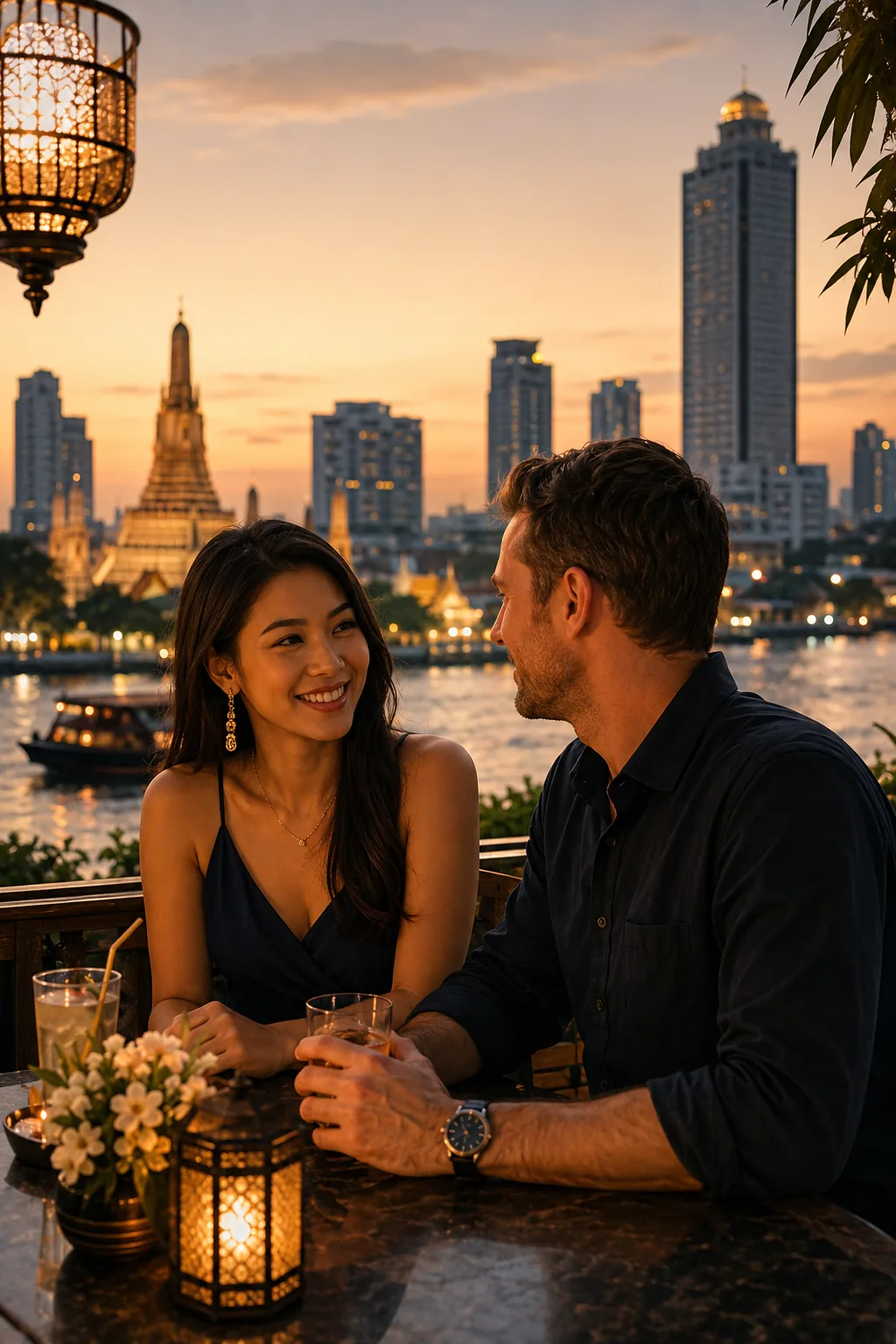
Affection Does Not Have One Thai Rule
Thailand can look contradictory if you expect one national standard for affection.
Official cultural guidance remains fairly reserved. Public hugging and kissing are discouraged in traditional visitor etiquette, particularly in religious settings. At the same time, anyone walking through a modern Thai city will see couples holding hands, sitting close together and behaving in ways that are clearly affectionate.
Both observations can be true.
Etiquette describes a cultural baseline, not every individual. Age, relationship, family background, location and setting all influence behaviour. A couple in a Bangkok mall, visitors on a Phuket beach and people attending a temple ceremony are not operating in identical social environments.
The useful rule is therefore not “Thai couples do this”.
It is “respect the setting and the person”.
Official Etiquette Is Fairly Reserved
Current Thailand.go.th guidance from the Ministry of Culture advises against public hugging and kissing and against greeting Thai people — particularly women — with hugs or kisses. It also advises visitors not to embarrass people publicly.
This is useful background because foreign greeting habits can feel more physically familiar than Thai norms, especially with people you have only just met.
But official etiquette should not be exaggerated into law or universal behaviour. Public affection is not automatically illegal, Thai couples do not universally avoid touch and there is no evidence that every Thai person shares the same comfort level.
Think of the guidance as a reason to begin slightly more reserved than presumptuous.
The relationship can tell you the rest.
A Greeting Is Not a Date
Physical contact means different things at different stages of a relationship.
A cheek kiss used as a routine greeting in parts of Europe may feel surprisingly intimate when meeting a Thai person for the first time. A hug between established partners is different from a hug imposed on somebody during an introduction.
This distinction matters because visitors sometimes confuse friendliness with consent to physical familiarity.
A smile is not an invitation.
Politeness is not an invitation.
Agreeing to a date is not an invitation to every form of touch.
Let physical familiarity develop naturally and reciprocally instead of assuming that one cultural model applies.
Temple, Mall, Beach, Bar
Context changes almost everything.
At a temple or sacred site, restrained behaviour is appropriate. Religious space is not simply another scenic backdrop for romantic photos or physical affection.
A shopping mall or park may feel more relaxed, but people still differ.
A beach area with many international tourists may create yet another social atmosphere.
Nightlife can be physically and socially looser without erasing anyone's personal boundaries.
The mistake is using the setting as evidence of permission. Being in a bar does not mean someone wants to be touched. Being in private does not mean consent has been given. Being in a conservative setting does not mean a partner lacks affection.
Place matters.
Person matters more.
Heads and Feet
Thai visitor guidance still describes the head as culturally respected and the feet as low. Visitors are advised to avoid casually touching another person's head, pointing at people or objects with their feet, and stepping over people or culturally significant objects.
These conventions can be useful in dating, family and social settings, especially when you do not know somebody well.
Keep them proportional.
Accidentally brushing someone's hair is not a relationship catastrophe. What matters is the general habit of showing respect rather than treating somebody's body carelessly.
The same principle applies to feet: awareness is enough. You do not need to spend the date monitoring every angle of your shoes.
Personal Space Is Personal
There is no reliable modern Thai dating research giving a universal distance that people prefer between bodies. Do not invent centimetre rules.
Some people naturally stand close.
Some need more space.
Crowded urban environments create different habits from quiet private settings.
Romantic partners usually behave differently from strangers.
Cultural background may influence comfort, but personal boundaries remain personal.
The safest way to understand somebody's physical style is not to analyse national body language. It is to notice whether contact is reciprocated and to ask when you are unsure.
Do Not Decode Body Language Like a Manual
Dating advice often treats body language as a secret language with fixed meanings.
She touched your arm.
He sat closer.
She did not move away.
He smiled.
None of these is a substitute for consent or clear communication.
People can be friendly without being romantically interested. Someone can freeze or remain polite when uncomfortable. A person may enjoy one type of contact and dislike another.
Cultural theories become especially dangerous when they are used to reinterpret hesitation as permission.
Do not search for the hidden yes.
Look for an actual yes.
Consent Is Specific and Ongoing
Consent is not granted once for the entire evening.
Agreeing to hold hands does not mean agreeing to kiss.
Agreeing to kiss does not mean agreeing to sex.
Going to someone's home does not automatically grant permission for anything else.
Being in an established relationship does not remove the need for consent.
This is ordinary relationship ethics, not a special Thailand rule.
Culture can affect how comfortable people feel saying no or creating embarrassment, which is exactly why respectful clarity matters. If somebody seems uncertain, slow down. If they say no, stop. If you are unsure, ask.
Alcohol Does Not Create Permission
Nightlife can blur judgment.
Alcohol can make people more expressive, less coordinated or less able to communicate clearly. None of that creates permission.
Do not treat intoxication as an opportunity to push past boundaries. Do not use the fact that someone chose to drink with you as evidence of sexual interest. If a situation becomes unclear, waiting is safer than interpreting.
This applies equally to everyone.
Consent is not a nationality issue and it is not a gender privilege.
Photos and Social Media Are Boundaries Too
Modern relationships create a second layer of public affection: visibility online.
One partner may enjoy posting couple photographs.
Another may keep relationships private.
A person may be comfortable with a photo being taken but not with it being uploaded publicly.
Do not assume that being photographed together creates permission to tag, post or share intimate details. Likewise, privacy online is not automatic evidence that someone is hiding a relationship.
Social media boundaries deserve the same ordinary conversation as physical ones.
Different Affection Styles Do Not Mean Different Feelings
One partner may be physically affectionate in public.
The other may be warmer in private.
One may use words.
The other may show care through practical actions, time or family involvement.
Cross-cultural couples can misread these differences as emotional inequality.
Sometimes they are.
Sometimes they are simply different styles.
The solution is not to measure affection against a stereotype of Thai reserve or Western openness. Ask what makes each person feel cared for and what kinds of public behaviour feel comfortable.
The Thailand4U Take
Thailand's public etiquette is a useful reason to begin respectfully and avoid assuming physical familiarity.
It is not a rigid map of modern relationships.
Different places, generations and individuals behave differently. Traditional body etiquette around heads and feet remains useful background. Public affection may be more restrained in some settings.
But the central rule is simpler than culture.
Respect the setting.
Respect the person.
Never guess at consent.