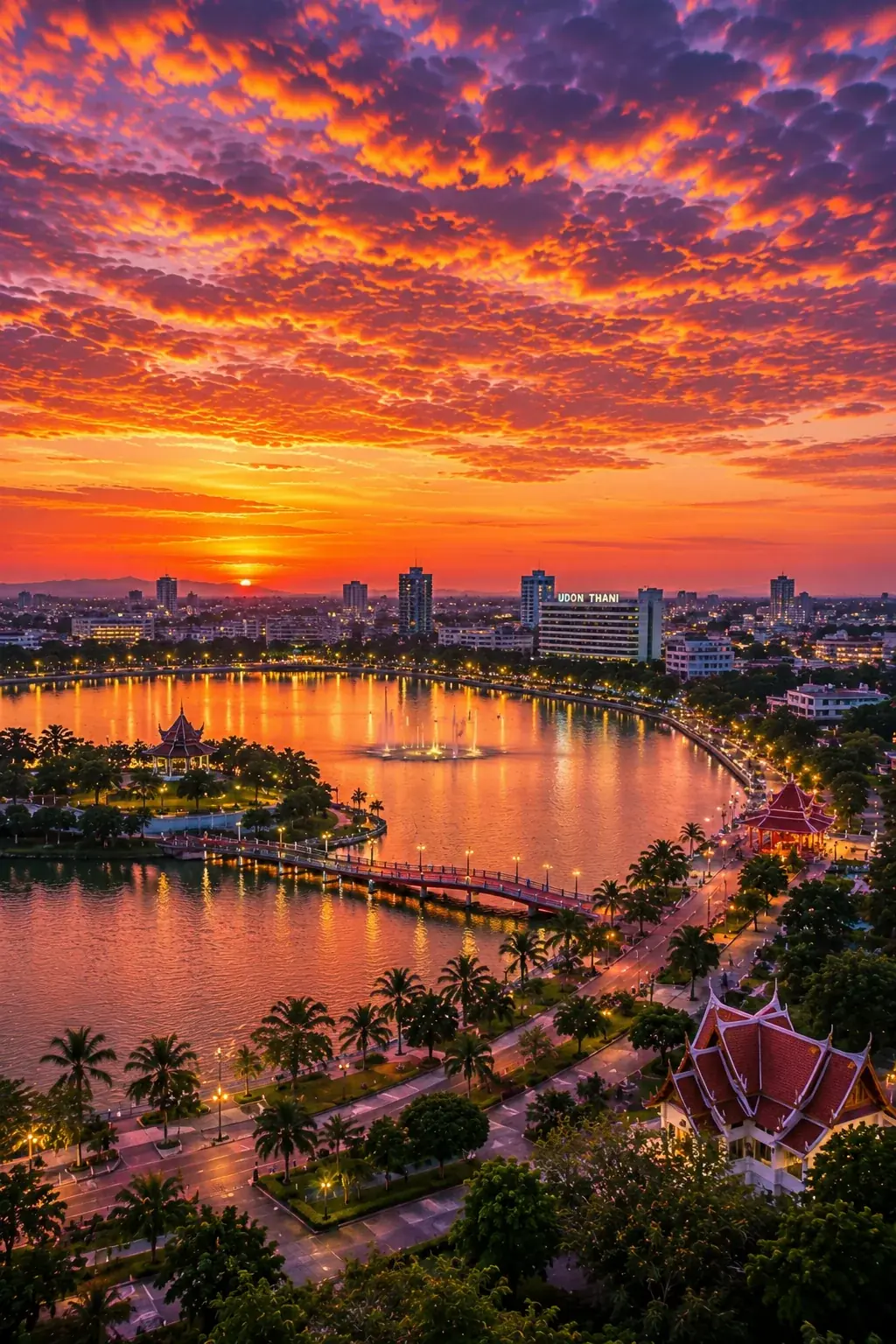
Udon Thani is one of the easiest cities in which to get a feel for upper Isan.
It is large enough to offer an airport, major shopping, hospitals, markets, nightlife and strong transport links, but compact enough that the central city is relatively easy to understand. That balance makes Udon practical for a short visit and a useful base for exploring the wider province.
The city itself is modern and local. The province around it adds archaeology, sacred sites, rural landscapes and some of northeastern Thailand’s most distinctive seasonal attractions.
A COMPACT REGIONAL HUB
Udon Thani is an important commercial and transport centre in northeastern Thailand.
The central city is relatively concentrated, making it easier for a first-time visitor to move between restaurants, shopping, markets and evening areas.
Rail, road and air connections also make Udon a useful stop on longer journeys through Isan.
Its location places it within easy onward reach of Nong Khai and the Lao border, while routes continue south towards Khon Kaen and Bangkok.
NONG PRAJAK AND THE GREEN SIDE OF THE CITY
Nong Prajak Silpakom is one of Udon Thani’s most recognisable urban spaces.
The large lake and surrounding park are popular for walking, jogging, cycling and relaxing, especially in the cooler parts of the day.
It gives Udon a softer side away from the commercial streets and transport hubs.
The park is also one of the easiest places to understand the city’s everyday rhythm, with local residents using the area for exercise, family time and evening walks.
FOOD, MARKETS AND EVERYDAY LIFE
Food is one of Udon’s strongest everyday attractions.
Isan favourites are easy to find throughout the city, including som tam, grilled chicken, sticky rice, spicy salads, soups and grilled meats.
Udon also has strong links with Lao-influenced food culture, reflecting its location in upper Isan and proximity to the Mekong region.
Markets are one of the best ways to experience this side of the city.
Fresh markets, evening food stalls and larger night-market areas combine local dishes, snacks, clothes and everyday shopping.
UD Town and the surrounding central area add a more modern evening atmosphere with restaurants, shops and places to sit out after dark.
SHOPPING AND THE MODERN CENTRE
Modern shopping is a visible part of Udon Thani.
Central Udon and the surrounding commercial district bring together restaurants, cafés, retail, supermarkets and entertainment.
The malls are useful for visitors, but they also reflect how the city functions for local residents.
One of Udon’s strengths is that the modern shopping district sits relatively close to traditional markets, the railway station and several evening areas.
That makes the centre feel connected rather than spread across distant parts of the city.
NIGHTLIFE – SMALL, CENTRAL AND EASY TO FIND
Udon Thani has a real nightlife scene, although it is small compared with Thailand’s major nightlife destinations.
Bars, live music, restaurants and late-night venues are concentrated more tightly than in many other Isan cities.
Some of the central nightlife has an international element because Udon has a long-established foreign-resident and repeat-visitor community, but most of the city still runs on local rhythms.
The result is enough evening choice for a night out without nightlife defining the destination.
BAN CHIANG – A MUCH DEEPER HISTORY
One of the most important places in Udon Thani Province is Ban Chiang.
The archaeological site is UNESCO World Heritage listed and preserves evidence of prehistoric settlement, agriculture, pottery and bronze-working in Southeast Asia.
It is one of the strongest reasons to look beyond the modern city.
Ban Chiang is outside central Udon, so it should be treated as a proper excursion rather than a quick urban stop.
For visitors interested in archaeology and early Southeast Asian history, it can easily become one of the highlights of the province.
PHU PHRABAT – WORLD HERITAGE IN THE LANDSCAPE
Phu Phrabat is another major historical site in Udon Thani Province.
Its landscape combines unusual rock formations, prehistoric rock art and sacred boundary stones associated with the Dvaravati period.
The site was inscribed on the UNESCO World Heritage List in 2024.
That gives Udon Thani Province two very different UNESCO World Heritage stories: Ban Chiang for prehistoric settlement and technology, and Phu Phrabat for a cultural landscape shaped by both nature and religious tradition.
Phu Phrabat is well outside the city and needs to be planned as a regional trip.
THE RED LOTUS SEA
The Red Lotus Sea at Nong Han Kumphawapi is one of Udon Thani Province’s most famous natural attractions.
During the main flowering season, large areas of the lake fill with pink-red water lilies.
The best-known season is generally from December to February, and morning is the key time to visit because the flowers are at their most open earlier in the day.
Boat trips take visitors out onto the lake.
This is a seasonal experience, so it is important to check current conditions before planning a trip around it.
SACRED PLACES AND LOCAL BELIEF
The wider province also contains important religious and spiritual sites.
Wat Pa Phu Kon is one of the best known, set in a forested landscape away from the city.
Kham Chanot is another major destination associated with naga beliefs and local religious tradition.
These places are part of a broader Isan cultural landscape where Buddhism, local belief and regional identity often overlap.
They also show why Udon Thani works better when you think beyond the city centre.
GETTING AROUND
The central city is relatively manageable, but you will still need transport for many journeys.
Ride-hailing, tuk-tuks, taxis and local transport are useful within Udon.
Walking works best within the central commercial area, around Nong Prajak and within individual market or nightlife districts.
For provincial attractions such as Ban Chiang, Phu Phrabat, Kham Chanot or the Red Lotus Sea, private transport, organised transport or careful public-transport planning is much more practical.
Distances across the province are significant.
HOW LONG SHOULD YOU STAY?
Two nights is enough for a quick look at central Udon.
Three or four nights gives you time to explore the city and add one or two provincial excursions.
Longer stays make sense if you want to see several major attractions or use Udon as part of a wider route through upper Isan and towards Nong Khai.
Udon Thani’s strength is not one single headline sight.
It is the combination of an easy regional city and a province with unusually varied reasons to explore.
You can spend one evening at a market, the next morning beside a lake, and another day standing among archaeological remains or unusual rock formations.
That range is what gives Udon Thani a character of its own.