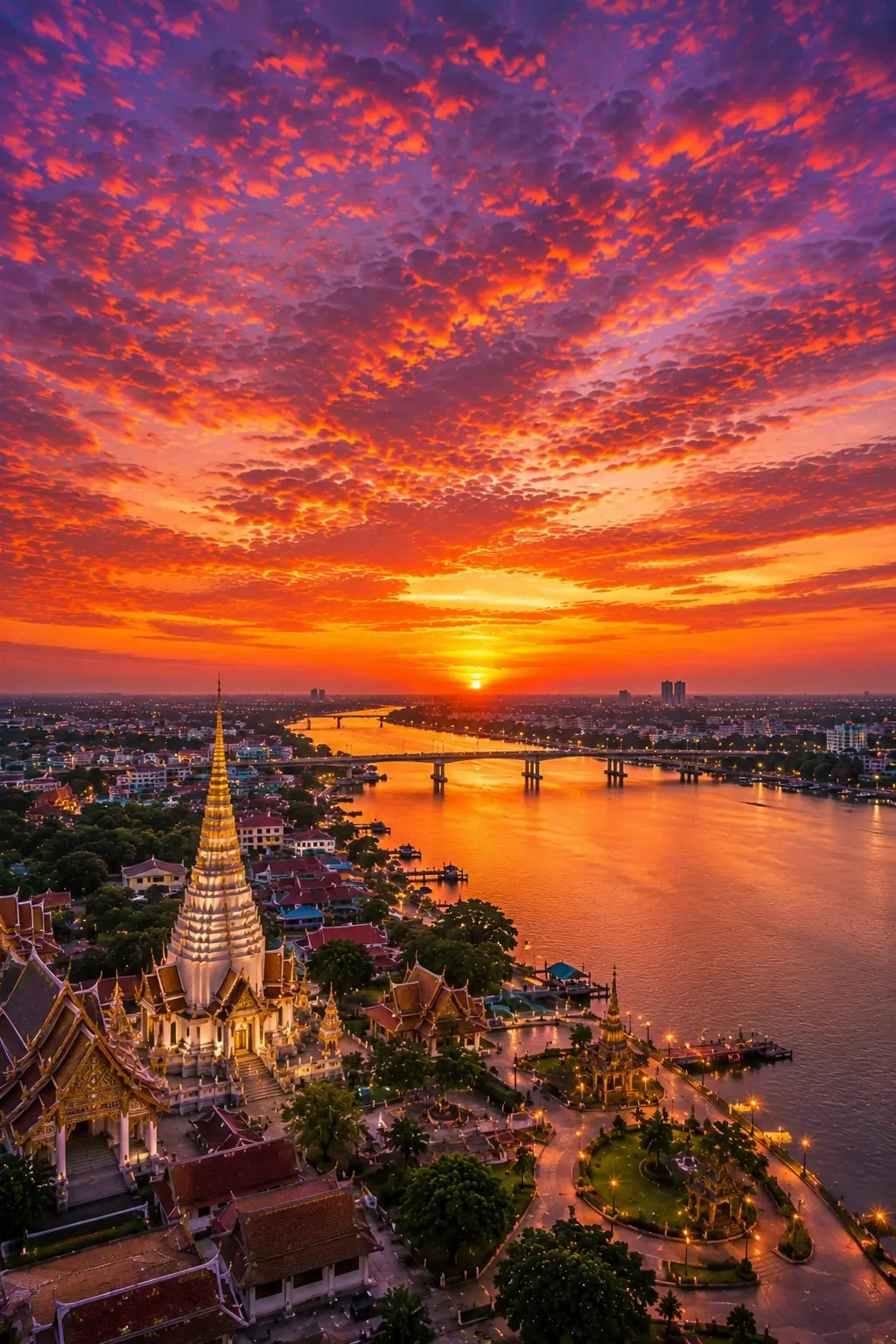
Nonthaburi is one of the easiest places to see how Greater Bangkok shifts into a different kind of urban Thailand.
It forms part of the Greater Bangkok metropolitan area, but its identity is strongly tied to the Chao Phraya River, old settlements, fruit-growing communities, temples and river transport.
At the same time, Nonthaburi is highly urbanised.
Large residential districts, shopping centres, expressways and modern rail lines make it a practical place to live and travel.
That combination of old river culture and metropolitan growth is the key to understanding the destination.
BANGKOK’S NEIGHBOUR, WITH AN IDENTITY OF ITS OWN
Nonthaburi sits directly north of Bangkok.
The urban fabric often feels continuous, especially along major roads and rail corridors, but the province has its own history, administrative centre and local character.
The closer you move towards the river and older communities, the more distinct that character becomes.
Temples, piers, markets and traditional neighbourhoods make parts of Nonthaburi feel very different from central Bangkok.
THE CHAO PHRAYA RIVER
The Chao Phraya is one of Nonthaburi’s defining features.
The river connects old communities, temples, markets and residential areas and has shaped the province for centuries.
River travel also offers one of the most enjoyable ways to approach Nonthaburi from Bangkok.
The journey north by boat gives a gradual transition from the dense city centre towards a greener and more local riverside landscape.
NONTHABURI TOWN
The provincial centre sits along the river and remains one of the most practical places to experience everyday Nonthaburi.
Markets, government buildings, temples, local restaurants and piers sit close together.
The old city hall and the Nonthaburi Museum help explain the province’s civic history.
The area feels busy and local rather than designed primarily for tourism.
KOH KRET
Koh Kret is Nonthaburi’s best-known visitor attraction.
The island sits in the Chao Phraya River near Pak Kret and is closely associated with Mon culture, handmade pottery, temples, food stalls and a relaxed walking-and-cycling atmosphere.
Weekend visits are especially popular because more shops and stalls are open.
Weekdays are quieter and some businesses may be closed.
Koh Kret is best experienced slowly.
Walk or cycle around part of the island, try local snacks, visit pottery workshops and leave time for the river.
PAK KRET AND THE NORTH-EASTERN SIDE
Pak Kret is a major urban centre in its own right.
It combines local neighbourhoods, shopping, transport, river access and the gateway to Koh Kret.
The wider Pak Kret area also connects towards Muang Thong Thani and Chaeng Watthana.
This side of Nonthaburi feels more modern and metropolitan than the old riverfront.
MUANG THONG THANI
Muang Thong Thani is one of Nonthaburi’s major modern districts.
It is known for large event venues, residential development, restaurants and convention infrastructure.
Major exhibitions, concerts and events can create sudden spikes in visitor numbers.
The Pink Line now links Nonthaburi Civic Center with Pak Kret, Chaeng Watthana and the wider northern metropolitan corridor, while the Muang Thong Thani branch brings rail directly into the event district.
SHOPPING AND MODERN NONTHABURI
Modern retail is a major part of everyday life in western and northern Nonthaburi.
Large malls and retail complexes, including the Bang Yai and Rattanathibet corridors, provide a very different experience from the river communities.
This side of Nonthaburi is practical rather than historic.
It is useful for shopping, dining, entertainment and everyday services.
FOOD AND LOCAL PRODUCE
Food is one of the easiest ways to experience Nonthaburi.
The province has long been associated with fruit-growing, especially durian and other orchard produce.
Along the river and on Koh Kret, local snacks, Thai dishes and Mon-influenced food traditions add another layer.
Markets remain important for casual eating and everyday shopping.
Nonthaburi is a good destination for visitors who enjoy eating where local residents eat.
TEMPLES AND HISTORICAL SITES
Nonthaburi has a large number of historic and active temples.
Some sit directly on the river, while others are embedded in modern neighbourhoods.
Sites such as Wat Chaloem Phra Kiat, Wat Leng Nei Yi 2 and temples around Koh Kret show different religious and architectural traditions.
The province’s history also reaches back through the Ayutthaya period, reflecting its strategic position along the river.
NIGHTLIFE
Nonthaburi has nightlife, but it is spread out.
Expect local bars, restaurants, live music venues, pubs and entertainment connected to shopping and residential districts.
There is no single tourism nightlife zone comparable with central Bangkok.
For most visitors, evenings are more about food, riverside atmosphere, local bars or event venues.
GETTING AROUND
Transport is one of Nonthaburi’s biggest strengths.
The MRT Purple Line provides access through several major parts of the province.
The Pink Line connects Nonthaburi Civic Center through Pak Kret and onwards along Chaeng Watthana.
Boats remain useful along the Chao Phraya.
Taxis and ride-hailing fill the gaps between rail stations, river piers and neighbourhoods.
Because Nonthaburi is spread across a large metropolitan area, it is important to check actual travel time rather than judging distance on a map alone.
HOW LONG SHOULD YOU STAY?
Many visitors experience Nonthaburi as a day trip from Bangkok.
That works well for Koh Kret, the riverfront or a specific temple or market.
One or two nights gives you more time to explore the river, local food and modern districts without commuting back into Bangkok.
Three nights can make sense if you have an event at Muang Thong Thani, want to explore several parts of the province or simply prefer a quieter base outside central Bangkok.
Nonthaburi is not defined by one headline sight.
Its appeal comes from the transition between old river communities and modern metropolitan Thailand.
That contrast is what gives the province its character.