Chiang Mai is one of Thailand’s easiest cities to enjoy slowly.
Its centre is compact enough for wandering, but the wider destination stretches from old city walls and riverside neighbourhoods to mountain roads, national parks and villages outside the urban core.
The result is a city that can feel historic, creative, relaxed and outdoors-focused within the same trip.
THE OLD CITY
The moat and surviving walls define Chiang Mai’s historic core.
Inside and around them are many of the city’s best-known temples, guesthouses, cafés, small restaurants and traditional streets.
Wat Phra Singh and Wat Chedi Luang are among the major landmarks.
The Old City is particularly useful for first-time visitors because so much history, food and everyday city life can be reached on foot.
THA PHAE AND THE EASTERN GATE
Tha Phae Gate is one of Chiang Mai’s best-known meeting points and an important entrance to the old walled city.
The surrounding streets link the Old City with the Night Bazaar and riverside side of town.
On Sundays, the walking-street market extends along Ratchadamnoen Road through the historic centre.
This part of Chiang Mai feels especially lively in the late afternoon and evening.
NIMMAN
Nimmanhaemin Road and the surrounding streets form Chiang Mai’s strongest contemporary café, dining and lifestyle district.
The area is known for coffee, restaurants, bars, boutique shopping and a younger urban atmosphere.
It sits west of the Old City, closer to Chiang Mai University and the road towards Doi Suthep.
Nimman works well for repeat visitors and travellers who want modern city life without giving up quick access to Chiang Mai’s historic centre.
NIGHT BAZAAR AND CHANG KHLAN
The Night Bazaar side of Chiang Mai has long been associated with shopping and evening activity.
Hotels, restaurants, markets and tourist services are concentrated along and around Chang Khlan Road.
The area is convenient for travellers who like activity after dark and easy access to the Ping River side of the city.
It feels more commercial than the Old City but remains a practical base.
THE PING RIVER
The Ping River gives Chiang Mai another rhythm.
Restaurants, cafés, older buildings and quieter streets line parts of the river corridor.
Some visitors choose the riverside for a more relaxed stay away from the densest tourist streets.
It is also a useful reminder that Chiang Mai is not defined only by the square Old City.
DOI SUTHEP
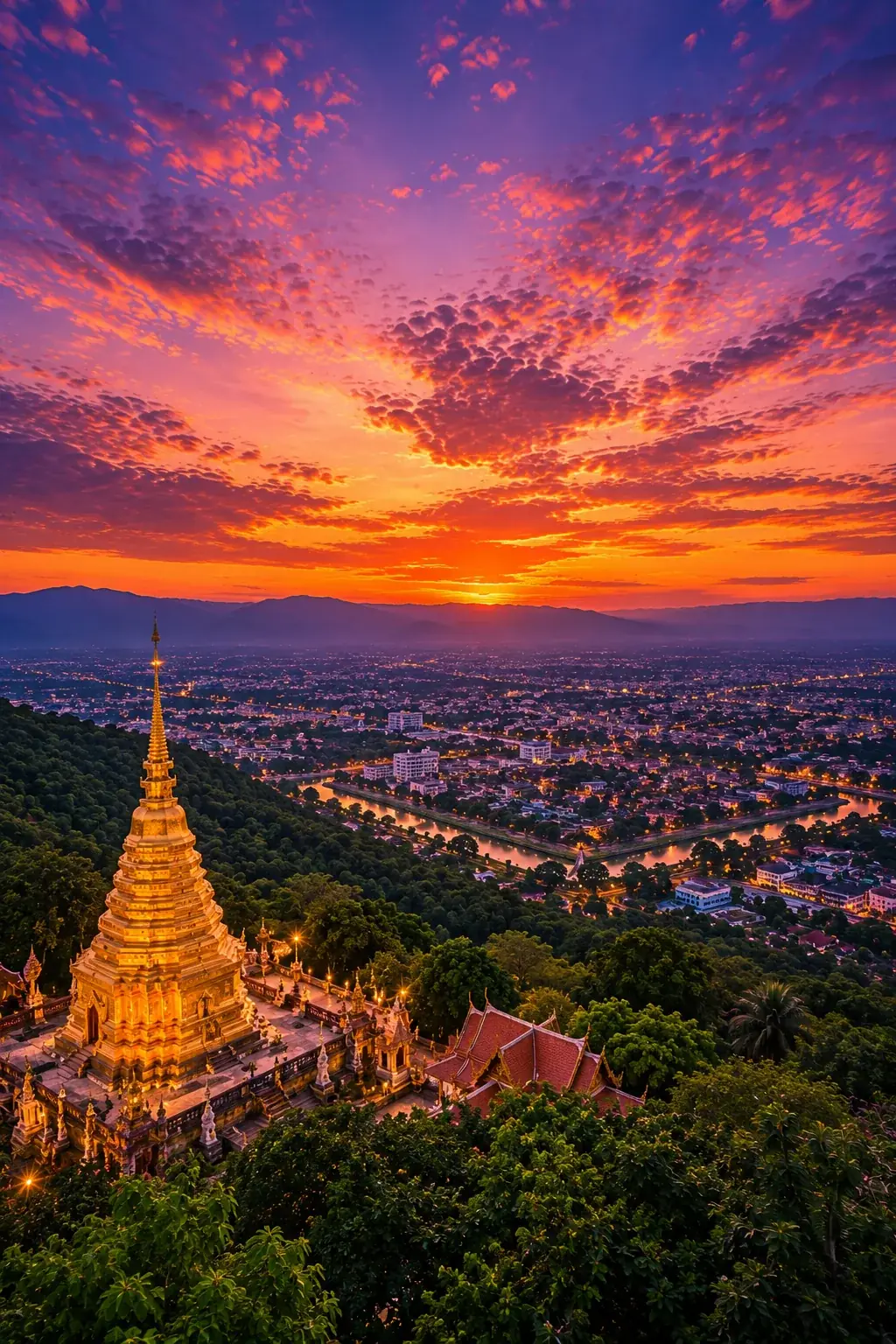
Wat Phra That Doi Suthep is one of Chiang Mai’s defining landmarks.
The temple sits on the mountain west of the city and is both an important religious site and a major visitor attraction.
Go respectfully.
Dress appropriately, keep noise low and remember that this is an active Buddhist temple rather than simply a viewpoint.
The mountain road also connects with Doi Pui and additional forest and village landscapes.
MARKETS
Markets are central to Chiang Mai.
The Sunday Walking Street is the most famous visitor market, but the city also has night markets, food markets and everyday local markets with very different identities.
Warorot Market is especially useful for local food products, snacks, clothing and everyday Chiang Mai commerce.
Markets are one of the best ways to see the city beyond temples and cafés.
NORTHERN FOOD
Chiang Mai is one of Thailand’s strongest food destinations.
Khao soi is the obvious signature dish for many visitors, but northern cuisine also includes sai ua, nam prik ong, nam prik num and other Lanna and northern Thai flavours.
The city ranges from simple market stalls to established local restaurants and ambitious modern dining.
Do not reduce the food scene to one dish.
CAFÉS AND CREATIVE LIFE
Chiang Mai has developed a major café and creative scene.
Nimman is the most visible centre, but good coffee and design-focused businesses are spread across the city.
Craft traditions, contemporary design, ceramics, textiles and small independent shops all contribute to Chiang Mai’s modern identity.
This contemporary side works best when presented alongside, not instead of, the city’s Lanna heritage.
DAY TRIPS AND THE WIDER PROVINCE
Chiang Mai city is only one part of the destination.
Doi Inthanon, Mae Kampong, Doi Ang Khang, Queen Sirikit Botanic Garden and mountain communities extend the experience well beyond the urban area.
These are real excursions rather than neighbourhoods of central Chiang Mai.
Travel times vary substantially, and some mountain trips deserve a full day.
NATURE
The mountains around Chiang Mai are a major reason to stay longer.
National parks, waterfalls, gardens, forest roads and viewpoints can be reached on day trips.
Conditions change with season.
Waterfalls, visibility and mountain temperatures should never be assumed from city-centre weather alone.
NIGHTLIFE
Chiang Mai has nightlife, but it is spread across several different scenes.
Nimman has bars and more contemporary venues.
The Old City and Tha Phae side have traveller-oriented bars and live music.
The riverside has established evening venues.
Chiang Mai is lively enough for nights out without being defined by nightlife.
GETTING AROUND
Red songthaews are one of Chiang Mai’s most recognisable forms of local transport.
Ride-hailing, tuk-tuks and taxis are also widely useful.
The Old City is walkable, but the wider urban area is too spread out to treat entirely on foot.
For mountain trips and more distant attractions, private transport, tours or arranged drivers can save significant time.
AIR QUALITY AND THE LATE DRY SEASON
Northern Thailand can experience serious seasonal haze and PM2.5 pollution during the late dry season, with conditions often worst around March.
The exact timing and severity vary from year to year.
If travelling during the February–April period, check live air-quality information close to the trip rather than relying on a fixed “burning season” date.
Poor air can affect views, hiking and outdoor comfort.
HOW LONG SHOULD YOU STAY?
Three nights gives you a quick city introduction.
Four to six nights is better for a first visit because it leaves room for temples, markets, food, Doi Suthep and at least one substantial excursion.
A week or more works well for slower travel, cafés, cooking, wellness or multiple mountain trips.
Chiang Mai’s strength is not a single attraction.
It is the way history, food, religion, creative life and northern landscapes overlap without making the city feel rushed.